


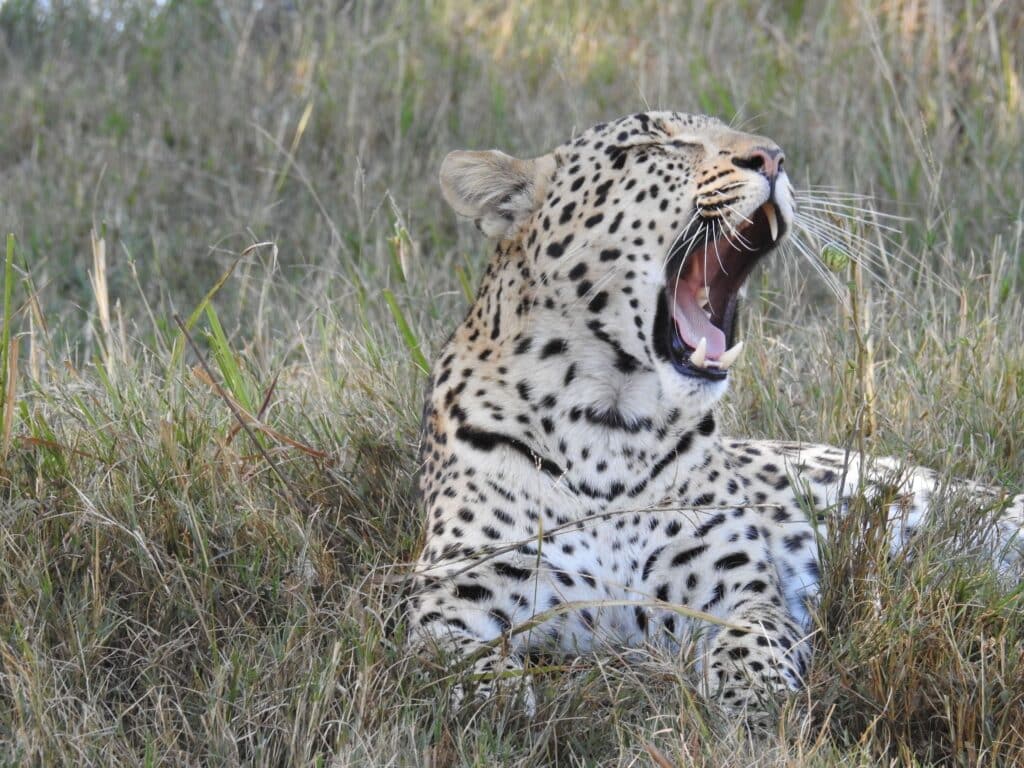
Cheetahs in Kruger National Park are among Africa’s most elusive big cats, inhabiting the open grasslands and savanna areas of South Africa’s premier wildlife reserve. While less common than lions and leopards, these magnificent predators can be spotted throughout Kruger’s diverse ecosystems, particularly in the central and southern regions where open terrain suits their hunting style.
You’re on a morning game drive, the air still cool and golden, and a sleek spotted cat rises from a termite mound to survey the plains. The world goes quiet for a few breathless seconds. That’s the magic of encountering cheetahs in Kruger National Park, and once it happens, you’ll understand why people return to this park year after year chasing that feeling.
The cheetah is unlike any other predator on the continent. While lions rely on brute strength and leopards on stealth, the cheetah’s entire body is engineered for one spectacular purpose: pure, extraordinary speed. As the world’s fastest land animal, it can accelerate from 0 to 100 km/h faster than most sports cars. But beyond the speed, what makes a Kruger National Park cheetah encounter so special is how alive it feels: raw, unscripted, and utterly wild. See how cheetahs and leopards compare for more detailed insights.
Stretching across 19,485 square kilometres of diverse South African wilderness, Kruger gives these cats the space they need to hunt, roam, and thrive. That same vast landscape can make spotting them a challenge, which only makes it all the more rewarding when you do.
Understanding the population of cheetahs in Kruger National Park
A conservation success story worth celebrating
The cheetah population in Kruger National Park is estimated at between 200 and 300 individuals, one of the most stable and genetically diverse populations anywhere in South Africa. That genetic health matters more than it might seem. Cheetahs here aren’t subject to the inbreeding pressures that threaten smaller, isolated populations because Kruger is so large and ecologically varied. In short, Kruger’s cheetahs are not just surviving, they’re genuinely thriving.
Research conducted in collaboration with the Endangered Wildlife Trust uses GPS collaring, camera traps, and aerial surveys to track these cats over time. What scientists have found is encouraging: individual cheetahs in Kruger maintain territories of 50 to 150 square kilometres, varying based on prey density and habitat quality. That’s a lot of ground to cover on a single game drive, which is why knowing where to look makes all the difference.
Where do cheetahs live in Kruger?
Not every corner of Kruger is equally suited to cheetahs. They’re open-country specialists; built for speed, not the dense bush that leopards prefer. To find a Kruger National Park cheetah, you need to think like one:
- Open grasslands offer the unobstructed sightlines cheetahs need to spot prey from a distance
- Scattered acacia trees and termite mounds provide elevated vantage points for scanning the landscape
- Short-grass areas near water concentrate prey animals and attract cheetahs in turn
- Mixed savanna gives them room to reach full speed during a chase
The central and southern regions of Kruger are best for wildlife safaris. Areas around Skukuza, Lower Sabie, and the Sabie River corridor are particularly productive, which is one reason Kruger Gate Hotel’s location along this stretch is such an advantage for guests hoping to spot these cats.
What makes cheetahs so remarkable?
It’s one thing to know that cheetahs are fast. It’s another to understand why, and once you do, watching one on a Kruger safari becomes a completely different experience.
Adaptation | What it does |
Lightweight, slender build | Cuts body weight to maximise speed |
Enlarged nasal passages | Pulls in more oxygen during high-speed chases |
Non-retractable claws | Act like running spikes, gripping the ground |
Highly flexible spine | Extends each stride dramatically |
Black “tear marks” on face | Reduce sun glare, improving daytime vision |
Every one of these features is the result of millions of years of evolution, all pointing toward the same outcome: a 20-to-60-second burst of hunting perfection. When the chase is over (whether successful or not) a cheetah may spend up to 30 minutes recovering, panting heavily to bring its body temperature back down. If you’re lucky enough to witness a hunt on a cheetah Kruger safari, don’t rush away. Watching the aftermath is a story in itself.
How do they hunt?
Unlike the ambush tactics of leopards, or the coordinated group hunts of lions, cheetahs rely on daylight, open space, and speed. Their method follows a distinctive sequence:
- Scout: Scanning the plains from a high point, often a termite mound or fallen tree
- Stalk: Moving slowly, using whatever cover is available, to close within 50–100 metres of prey
- Sprint: An explosive, short-duration chase at speeds reaching 100 km/h
- Recover: Resting before eating, often in a state of exhaustion
This reliance on speed and daylight is exactly why cheetahs on a Kruger safari are spotted more often than leopards, when the conditions are right, there’s nowhere to hide.
When is the best time to see cheetahs in Kruger?
Dry season (May to September): The prime window
Plan to visit during the dry winter months if seeing cheetahs is a priority for your trip. As vegetation thins and water sources shrink to predictable points, wildlife concentrates, and game viewing becomes dramatically more productive.
Visibility is excellent, with sparse grass making it easier to spot a resting or hunting cheetah
Animals cluster around rivers and waterholes, creating natural viewing hotspots
The cooler weather encourages cheetahs to be active later into the morning
Wet season (October to April): A different kind of magic
The green season is largely overlooked, but it has real appeal for the patient wildlife photographer. Prey animals give birth during this period, which means more vulnerable animals, and more active cheetahs. The dramatic afternoon thunderstorms also make for extraordinary photographic backdrops.
The golden hours
Regardless of season, early mornings and late afternoons are when cheetahs in South Africa are most active. The midday heat pushes them into the shade, where they’re virtually invisible. Aim to be out on game drives between 6:00–9:00 AM and 4:00–6:00 PM for the highest chance of an encounter.
Tips for spotting cheetahs on safari
Cheetah sightings are never guaranteed, and that’s part of what makes them so special when they happen. But a few habits will dramatically improve your odds.
- Look up and out, not just down. Cheetahs regularly use termite mounds, rocky outcrops, and fallen trees as lookout posts. You’ll miss them if you’re only scanning the ground.
- Slow down in open areas. Cheetahs are remarkably well-camouflaged against dry grass. A slow, methodical scan of open terrain, especially near the edges of woodland, pays off.
- Watch other animals. Impala and other antelope will alert you to a predator’s presence. If a herd suddenly freezes and stares in one direction, follow their gaze.
- Keep quiet and patient. Once you’ve found a cheetah, switch off the engine and wait. The best moments (a stretch, a yawn, a sudden sprint) come to those who sit still.
Photography pointers
Telephoto lenses of at least 300mm give you close-up shots while respecting distance
Always maintain a minimum of 25 metres from the animal and follow your guide’s instructions
Shoot in burst mode during movement; cheetah behaviour changes in a fraction of a second
Focus on behaviour rather than static portraits: the story is in the action
Cheetahs in Kruger: Conservation challenges
Kruger National Park is one of the most important strongholds for cheetahs in South Africa, but these cats still face pressures that deserve attention.
Competition from larger predators is perhaps the most immediate challenge. Lions and spotted hyenas will steal a cheetah’s hard-won kill, and cheetah cubs are particularly vulnerable to predation. This is why female cheetahs often seek out areas with lower lion density, making some parts of Kruger more reliably productive for cheetah sightings than others.
Habitat fragmentation outside the park remains a long-term concern. Cheetahs are wide-ranging animals, and where human development encroaches on wildlife corridors, populations can become isolated from one another.
Climate variability increasingly affects prey distribution, rippling through the food chain and influencing where cheetahs can successfully hunt.
Kruger’s management responds to these pressures through habitat preservation, anti-poaching patrols, ongoing population research, and community engagement programmes designed to build support for conservation beyond the park’s borders.
Why Kruger Gate Hotel is your best base for a cheetah safari
Location matters enormously if your goal is to maximise your time in prime cheetah country. Kruger Gate Hotel sits directly adjacent to the Kruger National Park, meaning guests can be inside the park within minutes of leaving their accommodation. No long transfers, no wasted morning light.
Better still, the hotel sits along the Sabie River corridor, one of the most ecologically rich and consistently productive areas in the entire park for iconic wildlife viewing. The riverine habitat here supports large prey populations, which in turn supports healthy numbers of cheetahs in Kruger National Park.
Professional guides based at the hotel bring an intimate, ground-level knowledge of local wildlife patterns, including the territories and routines of individual cheetahs known to frequent the area. That kind of local expertise is invaluable, turning a good safari into an unforgettable one.
Frequently asked questions
How many cheetahs live in Kruger National Park?
Current estimates put the population at between 200 and 300 individuals. This is one of the most stable cheetah populations in South Africa, supported by the park’s size, genetic diversity, and active conservation management.
What’s the best time of day to see cheetahs on safari?
Early morning (6:00–9:00 AM) and late afternoon (4:00–6:00 PM) are your best windows. Cheetahs avoid the midday heat, so the middle of the day is typically quiet.
Where in Kruger are cheetahs most commonly spotted?
Central and southern Kruger, particularly the areas around Skukuza, Lower Sabie, and the Sabie River, offer the open grassland habitat that cheetahs prefer.
How fast can a cheetah actually run?
Top speed exceeds 100 km/h, but most hunts happen at 50–80 km/h. The sprint itself lasts only 20–60 seconds before the cheetah needs to stop and recover.
Are cheetah sightings guaranteed?
No wildlife sighting in a natural environment can ever be guaranteed, and honestly, that uncertainty is part of the appeal. Each encounter is earned, which is what makes it so memorable.
How do I tell a cheetah apart from a leopard?
Look for the tear marks: two dark lines running from the inner corners of the eyes to the mouth. Cheetahs also have solid spots (not the rosette patterns of leopards), slender builds, and a preference for open grassland over dense bush.
What should I do if I spot a cheetah?
Stay calm, keep quiet, and switch off the vehicle engine if possible. Maintain at least 25 metres of distance, follow your guide’s lead, and let the animal behave naturally. The less you intrude, the more you’ll see.
Final Thought
A cheetah encounter in Kruger National Park is the kind of wildlife moment that stays with you long after you’ve returned home: the image of a spotted cat balanced on a termite mound, scanning the plains with amber eyes, suddenly dropping into a crouch. It’s a privilege to witness, and one that Kruger’s landscapes and conservation efforts work hard to protect.
Making cheetahs a priority is always worth it, whether you’re planning your first Kruger safari or returning for the tenth time. From the comfort of Kruger Gate Hotel, just minutes from the park entrance and perfectly placed along the Sabie River, you’ll have every advantage in finding them.
Explore Kruger Gate Hotel’s guided safari packages and start planning your Kruger National Park cheetah experience today.