


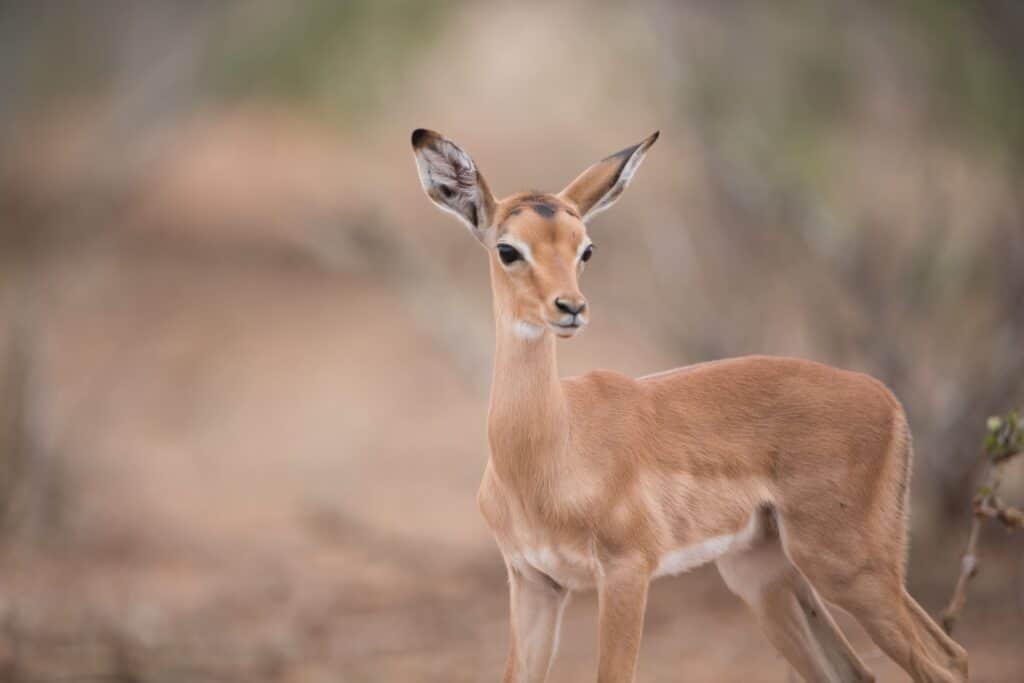
Kruger National Park is home to over 20 antelope species, making it one of Africa’s richest destinations for wildlife observation. The most commonly spotted Kruger National Park antelope include impala, greater kudu, and the rare Sable Antelope. Each species occupies a distinct habitat within the park. Kruger Gate Hotel, situated at Paul Kruger Gate, offers year-round access to these extraordinary animals from a luxury base.
Why Kruger National Park antelope’s diversity matters
Antelope are the heartbeat of the Kruger National Park ecosystem. They are the primary prey for lions, leopards, and wild dogs, meaning where antelope thrive, the full food chain follows.
Kruger National Park spans almost 20,000 km² of South Africa’s Limpopo and Mpumalanga provinces (Source: SANParks, 2024). This vast mosaic of bushveld, riverine forest, and open savanna supports an extraordinary range of South African antelope species year-round.
Understanding which antelope in Kruger National Park you may encounter (and where) enriches every game drive experience. This guide covers the three most iconic: the greater kudu, the impala, and the sable antelope.
The Greater Kudu: Majesty in the bushveld
The greater kudu (Tragelaphus strepsiceros) is one of Africa’s most visually striking antelopes. Bulls carry long, spiralling horns that can exceed 1.8 metres in length (Source: African Wildlife Foundation, 2023).
Kudu favour dense woodland and thicket, habitats common throughout the western and central regions of Kruger. They are browsers, feeding on leaves, shoots, and wild fruits rather than grass.
Key characteristics:
- Shoulder height: up to 1.5 m in males
- Distinctive white stripes along the flanks
- Exceptional vertical jumping ability, capable of clearing fences over 2 m high
- Highly alert; often detected by their loud bark alarm call
Kudu are most active during early morning and late afternoon. Their cryptic colouring makes them masters of concealment in dense bush, a rewarding spot on any antelope safari through the park.
Impala: The cornerstone species of Kruger
No species defines the Kruger landscape quite like the impala (Aepyceros melampus). Impala are by far the most abundant South African antelope species found in the park with an estimated population of over 150,000 in Kruger alone (Source: SANParks Wildlife Report, 2022).
Their ecological role is immense. Impala serve as a critical food source for nearly every large predator: lion, leopard, cheetah, wild dog, and crocodile, all depend on them.
Why impala are so successful:
- They are both grazers and browsers, adapting their diet to seasonal conditions
- Females give birth synchronously, flooding the environment with lambs to reduce individual predation risk
- They live in large herds, providing collective vigilance against predators
The Rut: A spectacular annual display
Each year, usually between May and July, male impala engage in intense territorial rutting behaviour (Source: Smithsonian’s National Zoo, 2023). Rams emit loud, guttural roars and chase rivals relentlessly. It is one of the most dramatic behavioural events in Kruger, and it unfolds across the park regardless of the month you visit.
Impala are found throughout Kruger in open woodland and savanna fringe habitats. They are almost always visible, making them an ideal species for first-time visitors to observe predator-prey dynamics in real time.
Sable Antelope: Kruger’s rare dark beauty
The Sable Antelope (Hippotragus niger) is among the most sought-after sightings in Kruger National Park. Its jet-black coat (in adult males), white facial markings, and sweeping scimitar-shaped horns make it unmistakable.
Sable are far less common than impala or kudu. Kruger’s sable population has faced significant pressure over recent decades, and the species is now largely confined to the park’s northern regions, particularly around Pretoriuskop and Satara (Source: SANParks Biodiversity Report, 2021).
Sable antelope at a glance:
- Adult males are jet-black; females are chestnut-brown
- Horns can reach 1.6 m in length, among the longest of any antelope
- Strictly grazers, preferring medium-height grass on well-drained soils
- Highly territorial; bulls defend home ranges aggressively
A Sable sighting is never guaranteed, but the northern and south-western areas of Kruger offer the best habitat for this magnificent species.
Antelope species comparison: Kudu, Impala & Sable
|
Feature |
Greater Kudu |
Impala |
Sable Antelope |
|
Scientific name |
Tragelaphus strepsiceros |
Aepyceros melampus |
Hippotragus niger |
|
Kruger population |
Common |
Very abundant (~150,000+) |
Rare |
|
Diet |
Browser |
Grazer & browser |
Grazer |
|
Habitat |
Dense woodland |
Open woodland/savanna |
Northern & SW Kruger |
|
Horn length (male) |
Up to 1.8 m |
Short, lyre-shaped |
Up to 1.6 m |
|
Best viewing time |
Early morning/evening |
All day |
Early morning |
|
Rarity of sighting |
Moderate |
Very easy |
Difficult |
Other notable antelope in Kruger National Park
Beyond the headline three, Kruger hosts a rich supporting cast of South African antelope species. Each occupies a specific ecological niche.
- Waterbuck (Kobus ellipsiprymnus): Large, shaggy antelope always found near permanent water. Recognisable by the distinctive white ring on the rump.
- Steenbok (Raphicerus campestris): A small, delicate antelope found in open areas. Solitary and highly alert.
- Reedbuck (Redunca arundinum): Associated with tall grass and reed beds near rivers.
- Tsessebe (Damaliscus lunatus): One of Africa’s fastest antelope, found in open grassland in the park’s north.
- Eland (Taurotragus oryx): Africa’s largest antelope; a majestic, ox-like animal occasionally seen in open bushveld.
Each of these species contributes to the ecological balance that makes Kruger one of the world’s premier wildlife destinations.
How to maximise your antelope sightings in Kruger
Spotting antelope in Kruger National Park, particularly elusive species like sable, requires patience and the right approach. Follow these steps to improve your wildlife observation experience.
Step-by-step guide to better antelope sightings:
- Start game drives at first light. Antelope are most active in the cooler hours. Kudu and sable in particular move freely before the midday heat.
- Scan tree lines and thicket edges. Kudu blend into dense bush. Slow down at vegetation boundaries where woodland meets open ground.
- Watch impala behaviour as a predator indicator. A herd of impala staring in one direction, snorting, or bunching tightly signals a predator nearby.
- Focus on water sources in drier months. Waterbuck, impala, and kudu congregate near rivers and waterholes during dry periods.
- Use binoculars proactively. Sable are often spotted at distance in open grassland before they retreat into cover.
- Drive slowly and stop often. Speed is the enemy of wildlife spotting. Allow animals to reveal themselves.
- Note the habitat type. Matching species to habitat (dense bush for kudu, open savanna for impala, northern grassland for sable) focuses your search.
Your base for Kruger wildlife experiences
Kruger Gate Hotel is situated near the main entrance to Kruger National Park, placing guests within minutes of prime habitat for Kruger National Park antelope. The hotel operates year-round, reflecting the fact that Kruger’s wildlife is accessible and rewarding in every season.
The hotel’s location is unmatched for ready park access on an antelope safari, whether you are a first-time visitor hoping to photograph your first kudu or a returning guest seeking the elusive sable.
Explore our game drives and wildlife experiences to understand what a day in the bush from Kruger Gate Hotel looks like.
Frequently asked questions
How many antelope species live in Kruger National Park?
Kruger National Park is home to more than 20 antelope species, ranging from the abundant impala to rare species like the sable and roan antelope. The park’s diverse habitats, from dense woodland to open savanna, support this extraordinary variety.
Is the sable antelope easy to spot in Kruger?
Sable antelope are considered a rare and sought-after sighting. They are most commonly found in the northern and south-western regions of the park. A sighting is never guaranteed, but early morning drives in suitable grassland habitat improve your chances.
What is the best time of year to see antelope in Kruger?
Kruger National Park offers rewarding antelope sightings year-round. Impala are visible throughout all seasons. The dry winter months (May–September) often concentrate animals near water sources, while the green season brings the impala lambing season and dramatic rutting behaviour.
Are impala the most common antelope in Kruger?
Yes. Impala are by far the most abundant antelope in Kruger, with an estimated population exceeding 150,000 (Source: SANParks Wildlife Report, 2022). Their adaptability as both grazers and browsers allows them to thrive across nearly all habitats in the park.
Can I see antelope from the Kruger Gate Hotel?
Kruger Gate Hotel is located directly at Paul Kruger Gate, the main entrance to the park. Antelope (including impala and kudu) are frequently observed in and around the hotel grounds and the adjacent park boundary. Access to prime wildlife habitat begins immediately upon entering the gate.