


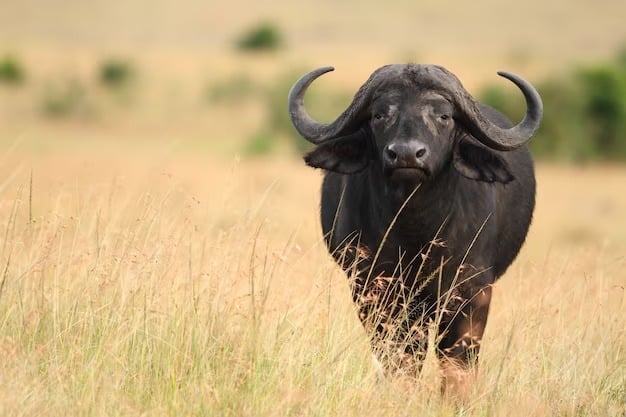
The African buffalo (Syncerus caffer) is widely considered the most dangerous and underrated member of the Big 5. Unlike lions or leopards, buffalo live in massive herds, display complex social behaviour, and have been known to turn on predators — including lions. Found throughout Kruger National Park year-round, they are a cornerstone of the African savanna ecosystem.
Why the African Buffalo deserves more respect
When travellers plan a luxury safari near Kruger National Park, the lion, leopard, and elephant tend to dominate the conversation. The African buffalo, however, is the animal that seasoned guides and wildlife researchers consistently single out as the most formidable — and the most misunderstood.
Often called “the Black Death” or “the Widow Maker” in local folklore, the African buffalo has earned a fierce reputation among South Africa’s wildlife communities. This is not hyperbole. The buffalo’s unpredictability, combined with its sheer size and herd dynamics, makes it a subject of genuine respect in the field.
What Is the African Buffalo?
The African buffalo (Syncerus caffer) is a large bovine native to sub-Saharan Africa. Adults can weigh between 500 and 900 kilograms, with bulls typically larger than cows
Their most distinctive feature is the boss — a fused, helmet-like horn structure that sits across the forehead of mature bulls. This hardened mass of bone and keratin can deflect blows from predators and rivals alike.
Unlike domesticated cattle, African buffalo have never been successfully tamed. They remain entirely wild, which contributes to their status within the Big 5 — a classification originally coined by big-game hunters to denote the five most dangerous animals to hunt on foot.
Buffalo behaviour: Complex, social, and fiercely protective
Herd structure and social dynamics
Buffalo live in mixed herds that can number in the hundreds, sometimes even thousands in areas like Kruger National Park. These herds are matriarchal in structure, with older females guiding movement and grazing decisions.
Within the herd, a behaviour known as “mobbing” has been documented — where the collective turns on a predator threatening one of their own. Footage of buffalo rescuing calves from lion prides has become iconic in wildlife circles, illustrating a level of social cohesion rarely seen among prey animals.
Older bulls often form smaller bachelor groups called dagga boys — a term derived from the Zulu word for mud, referencing their habit of wallowing in mud pools to cool down and repel parasites.
The Buffalo’s relationship with predators
Lions are the primary predator of buffalo, yet the dynamic is far from one-sided. A full-grown buffalo bull can weigh more than twice a lioness, and a cohesive herd can drive off an entire pride. Buffalo have also been documented killing lions — a fact that underscores why experienced wildlife professionals treat them with extreme caution.
Crocodiles prey on buffalo at river crossings, and spotted hyenas target calves and weakened individuals. Despite these pressures, buffalo populations in protected areas like Kruger remain stable.
African buffalo in Kruger National Park
Kruger National Park hosts one of the largest buffalo populations on the continent, estimated at over 37,000 individuals. They are distributed across the park’s diverse habitats — from the dense bushveld of the south to the open plains of the north.
Buffalo are not seasonal visitors. Unlike some migratory species, they remain present in Kruger throughout the year, making every month a viable time to encounter them. Whether you visit in the dry winter months, when vegetation thins and animals congregate around water sources, or during the lush green summer season, buffalo are a consistent presence in the landscape.
This year-round availability is one reason Kruger Gate Hotel positions itself as a true all-season destination — there is no “wrong time” to experience the Kruger ecosystem.
How to observe buffalo responsibly
Buffalo are not animals to approach carelessly. Even within the safety of a game vehicle, understanding their behaviour enhances both safety and appreciation. The following guide outlines what responsible wildlife observation looks like near buffalo herds.
Step-by-step guide to responsible buffalo observation
- Stay in the vehicle at all times. Buffalo are unpredictable and can charge with little warning. Vehicles are non-threatening to them when stationary and quiet.
- Observe herd body language. A relaxed herd grazes steadily. Raised heads, stiff posture, and fixed stares toward a vehicle or predator signal alertness.
- Watch for dagga boys. Solitary old bulls are often more aggressive than herd members. Give them additional space and do not position between them and cover.
- Note the wind direction. Buffalo have poor eyesight but an acute sense of smell. If the wind shifts toward the herd, they may react suddenly.
- Allow the herd to move at their own pace. Never attempt to redirect or hurry a herd crossing a road. Patience is both safer and more rewarding.
- Keep noise to a minimum. Loud voices or sudden sounds can startle individuals at the herd’s edge, triggering a chain reaction.
Buffalo vs. Other Big 5 Members: A comparison
Attribute | African Buffalo | African Lion | African Elephant | Leopard | White/Black Rhino |
Average weight (adult male) | 750 kg | 190 kg | 6,000 kg | 70 kg | 2,300 kg |
Primary threat to humans | Unpredictable charge | Predation | Charge/trample | Ambush | Charge |
Social structure | Large mixed herds | Prides | Family units | Solitary | Solitary/pairs |
Year-round presence in Kruger | Yes | Yes | Yes | Yes | Yes |
IUCN status | Near Threatened | Vulnerable | Vulnerable | Vulnerable | Near Threatened |
Conservation status and threats
The African buffalo is currently classified as Near Threatened on the IUCN Red List. While Kruger’s population is healthy, buffalo across the broader continent face pressure from:
- Habitat loss due to agricultural expansion
- Bovine tuberculosis (bTB), a disease documented in Kruger’s buffalo population that complicates management and movement
- Illegal hunting in unprotected areas
- Human-wildlife conflict along park boundaries
Kruger Gate Hotel is committed to supporting conservation awareness among its guests. Staying within a responsible, conservation-aligned property means your visit contributes to the
Experiencing buffalo from Kruger Gate Hotel
Positioned directly at the Paul Kruger Gate — the most iconic entrance to Kruger National Park — Kruger Gate Hotel offers guests immediate proximity to one of Africa’s greatest wildlife theatres.
After a morning in the park, guests return to Deluxe Rooms & Suites that blend African heritage with modern luxury — a genuine sanctuary after the intensity of the bush. The hotel’s Kudyela Restaurant and Lapa Restaurant serves cuisine inspired by the region’s cultural richness, making the full Kruger experience seamless from arrival to departure.
For those seeking restoration after time in the field, the African Spa — set within the hotel’s lush grounds — offers treatments rooted in African botanical traditions.
Corporate groups and private parties looking to combine the Kruger experience with professional events will find purpose-built facilities at our Corporate and Private Functions venue — a rare combination of boardroom capability and Big 5 proximity.
Ready to position yourself at the heart of the Kruger ecosystem? Contact Kruger Gate Hotel to plan your stay and discover why the African buffalo — and four other extraordinary animals — await you year-round.
FAQ
Is the African buffalo the most dangerous of the Big 5?
The African buffalo is widely regarded by wildlife professionals as among the most dangerous of the Big 5, primarily due to its unpredictability and tendency to charge without clear warning. However, all Big 5 animals carry inherent risk in the wild.
Can you see African buffalo in Kruger National Park year-round?
Yes. Buffalo are non-migratory residents of Kruger National Park and can be encountered in every season. There is no single “best” month — the park offers rewarding wildlife experiences throughout the year.
What is a dagga boy?
A dagga boy is a colloquial term for an older male buffalo that has left the main herd to live in smaller bachelor groups. These bulls are often considered more unpredictable than herd members and are treated with extra caution by experienced guides.
Are buffalo sightings guaranteed at Kruger Gate Hotel?
No. Wildlife sightings in any national park are never guaranteed, as animals move freely across vast, unfenced landscapes. Kruger Gate Hotel’s location at the Paul Kruger Gate provides excellent access to the park, but sightings depend on natural animal movement.
What do African buffalo eat?
African buffalo are grazers, feeding primarily on grasses. They require large quantities of water daily and are typically found near rivers, waterholes, and seasonal pans — making riparian zones in Kruger particularly productive for sightings.