


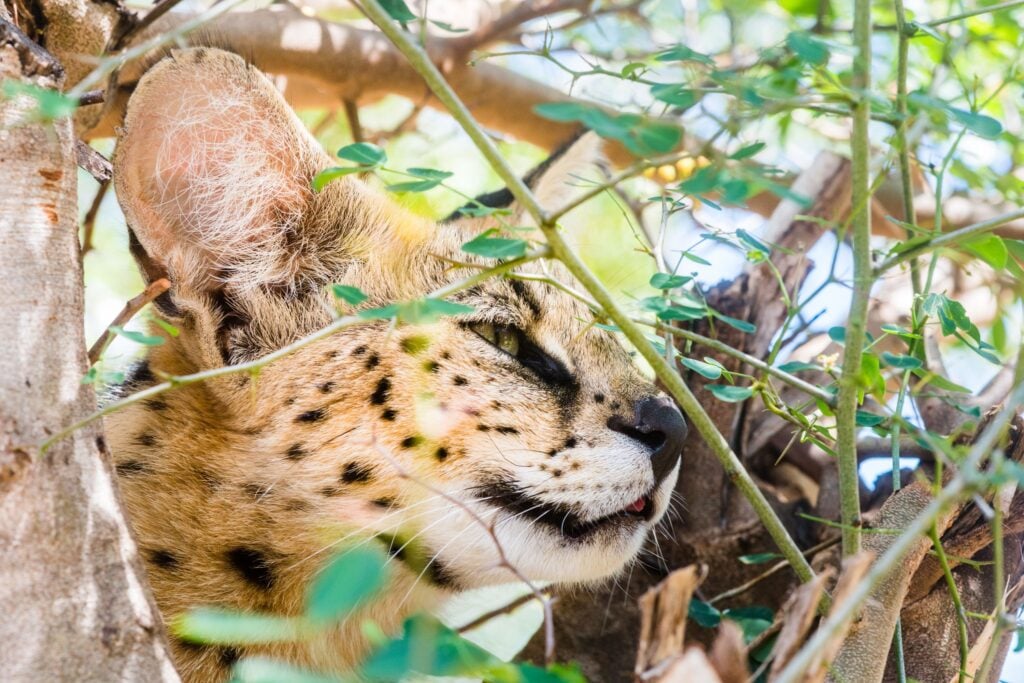
Kruger National Park hosts three primary African wild cats: the spotted Serval with its distinctive oversized ears, the tufted-ear Caracal, and the smaller African wildcat. These elusive feline species inhabit diverse ecosystems across Mpumalanga’s premier wildlife destination: Servals favouring grasslands near water, Caracals drawn to rocky outcrops, and African wildcats adapting to virtually any terrain the park throws at them.
You’ve spotted the lion. Now spot the African wild cats nobody talks about.
Most visitors leave Kruger National Park buzzing about the Big Five. And fair enough, there’s nothing quite like your first lion sighting or the adrenaline of watching a Leopard melt into the bush. But here’s what the seasoned safari-goers know: some of the most extraordinary moments in Kruger come from the animals you almost miss.
The wild cats of Kruger National Park, the Serval, the Caracal, and the African Wildcat, are masters of invisibility. They move through grasslands, rocky hillsides, and riverine forests with a quiet confidence that makes a sighting feel like a genuine gift. These smaller feline species demand your attention, your patience, and a little insider knowledge, unlike lions lounging in plain sight.
This guide gives you all three.
The Serval: Long-legged and lightning-fast
What makes a Serval unmistakable
The first time you see a Serval, your brain does a quick double-take. Those legs (impossibly long for a cat its size) give it the silhouette of a small cheetah, but the bold black spots and enormous, satellite-dish ears are entirely its own. Among all African wild cats, the Serval holds a unique record: it has the longest legs relative to body size of any cat on earth. At 60cm at the shoulder and a lean 12–15kg, it looks built for exactly one thing: hunting.
And hunt it does. Spectacularly.
Life near the water’s edge
In Kruger National Park, Servals are rarely far from water. They’re most at home in the tall grasslands and reed beds that fringe rivers like the Sabie and Crocodile, where the vegetation gives them cover to stalk and the wetlands deliver a steady supply of prey. Keep your eyes on the long grass at the road’s edge if you’re driving the H4-1 between Skukuza and Lower Sabie in the early morning.
Areas for heightened vigilance include:
- Wetland margins and floodplains
- Tall grasslands with dense stalking cover
- Reed beds along permanent rivers
- Transitional zones between bush and open ground
The hunter with radar ears
A Serval’s hunting success rate sits at around 50%, among the highest of all wild cats, and far better than the lion’s often-cited 20–30%. The secret? Those ears. They can rotate independently and pick up the underground movement of a rodent with extraordinary precision. A Serval will stand perfectly still in tall grass, head tilted, ears scanning, then launch itself in a vertical leap of over three metres to pin prey it couldn’t even see.
Small mammals make up roughly 90% of its diet, with birds, reptiles, amphibians, and insects rounding out the menu. Watching a Serval hunt is one of the genuine bucket-list moments among Kruger’s wild cats. Few things in nature feel quite as perfectly engineered.
The Caracal: Don’t call it a lynx
Power in a compact package
The Caracal is the cat that looks like it means business. Stocky, muscular, and utterly self-possessed, it weighs between 8 and 18kg, a wide range that reflects just how adaptable this species is. Those jet-black ear tufts, extending up to 5cm, are unmistakable in the field and have earned it the common nickname “African lynx,” though it’s not closely related to true lynxes at all.
The Caracal’s coat is a smooth, unmarked tawny (ranging from pale sand to rich reddish-brown) unlike the Serval’s eye-catching spots, which makes it remarkably effective camouflage against the rocky, scrubby terrain it favours. Among the types of wild cats in South Africa, the Caracal is arguably the most underrated predator.
Rocky country and thornveld
Where Servals hug the rivers, Caracals head for higher, drier ground. Rocky kopjes, dry woodland, and thornveld scrub are their strongholds in Kruger National Park; the kinds of landscapes you find in the central and western sections of the park, around Satara and Olifants camps. Add Caracal to your checklist if you’re scanning rocky outcrops for klipspringers or raptors. They use these formations as den sites, lookout posts, and food caches.
Ideal safari terrain includes:
- Rocky outcrops and boulder-strewn hillsides
- Dry woodland with good tree cover
- Thornveld and scrubland
- Mountainous terrain in western Kruger
Taking on prey twice its size
The Caracal’s hunting ability is frankly impressive. It can take down prey considerably larger than itself: impala lambs, steenbok, and guinea fowl are regular targets. And it has developed one of the more theatrical hunting moves in the animal kingdom: leaping three metres straight up to bat birds out of the air at the moment of takeoff. This skill, combined with its habit of stashing kills in trees to keep them away from scavengers, marks it as a genuinely sophisticated predator among the cat species in Africa.
The African Wildcat: Your cat’s great-great-grandparent
The original house cat
There’s something quietly extraordinary about encountering an African Wildcat in Kruger. At 3–6kg, it’s not far off the size of the cat currently asleep on your couch at home. That’s not a coincidence. The African Wildcat is the direct ancestor of every domestic cat on the planet. Thousands of years ago, these cats began associating with early human settlements in the Fertile Crescent, and the rest is history. The animal you’re looking at on your game drive is the original template.
In the wild, the resemblance to a domestic tabby is striking: sandy-grey coat, faint tabby markings, and a black-tipped tail with distinct banding. But a few clues give it away: notably longer legs, a wilder bearing, and reddish-brown colouring on the backs of the ears.
Small cat, big role
Don’t let its modest size fool you. The African Wildcat plays a meaningful role as a rodent controller within Kruger’s food web, keeping small mammal populations in check across diverse habitats from dense bushveld to open grassland. It’s also prey itself, for larger predators like Caracals and pythons, which places it at an important junction in the ecosystem.
What makes the African Wildcat particularly special among the wild cats of Kruger National Park is its adaptability. While Servals and Caracals have clear habitat preferences, the African Wildcat turns up almost anywhere in the park. It’s also the most commonly seen of the three, though “commonly” is relative when you’re talking about a cat this cryptic.
One conservation note worth knowing: outside protected areas, African wildcats increasingly hybridise with domestic and feral cats, diluting the gene pool over generations. Kruger’s protected status makes it one of the most important refuges for genetically pure African wildcats remaining in southern Africa.
Comparing Kruger’s three smaller African wild cats
Feature | Serval | Caracal | African Wildcat |
Weight | 12–15kg | 8–18kg | 3–6kg |
Shoulder Height | 60cm | 40–45cm | 25–30cm |
Coat Pattern | Bold black spots | Uniform tawny | Faint tabby |
Distinctive Feature | Oversized rounded ears | Black ear tufts | Reddish-brown ear backs |
Preferred Habitat | Grasslands, wetlands | Rocky terrain, scrub | Highly adaptable |
Primary Prey | Rodents, birds | Medium game, birds | Small mammals, insects |
Best Viewing Area | H4-1, Skukuza/Lower Sabie | Satara, Olifants | Throughout the park |
Practical tips for safari-goers
Time your drives right
All three species are most active at dawn and dusk, the classic crepuscular window when temperatures are cooler and prey is moving. If you can be on the road for:
- Dawn (5:30–7:00 AM): You’re catching cats returning from a night’s hunting, largely cutting across open ground or still active in long grass. This is statistically your best shot at a Serval.
- Dusk (5:00–6:30 PM): Animals are moving again after the midday heat, and the golden light is a bonus for photography.
Midday drives are perfectly enjoyable, but if a Wildcat sighting is your goal, early mornings earn it.
Roads worth driving slowly
- H4-1 (Skukuza to Lower Sabie): One of Kruger’s most productive roads for Servals, with riverine grassland habitat on both sides
- S65 (Satara to Orpen Gate): Rocky outcrops along this route make it excellent Caracal territory
- H6 (Letaba to Olifants): Mixed terrain that supports all three species, a good all-rounder
Read the Signs
You’ll regularly detect a wildcat’s presence before you see the animal itself. Fresh paw prints in sandy riverbeds, scat near territorial boundaries, scratch marks on prominent trees or rocks, these are the breadcrumbs. Experienced guides from accommodations near Paul Kruger Gate know these signs intuitively and can transform an ordinary morning drive into an extraordinary encounter.
Conservation: Why Kruger matters
The three smaller feline species in Kruger face varied pressures. Servals are classified as Least Concern globally but lose ground steadily to habitat loss and wetland degradation outside protected areas. Caracals maintain stable populations within the park, though human-wildlife conflict affects communities on Kruger’s periphery. African wildcats, as noted, face the slow genetic threat of hybridisation wherever they encounter domestic cats.
Within Kruger’s vast plains, all three species benefit from comprehensive anti-poaching measures, abundant prey, and, crucially, enough space to establish and maintain natural territories. The park’s position within the Greater Limpopo Transfrontier Park extends this protection further, enabling gene flow across international boundaries.
Ongoing research efforts (camera trap networks, GPS collar studies, and genetic sampling) continue to generate data that informs conservation strategies not just in Kruger but across the broader southern African landscape.
Frequently asked questions
What types of wild cats in South Africa can be found in Kruger National Park?
Kruger is home to eight wild cat species in total: lions, leopards, cheetahs, Servals, Caracals, African wildcats, black-footed cats, and small spotted cats. The three smaller species, Serval, Caracal, and African wildcat, are the most elusive, each occupying a distinct ecological niche within the park’s diverse habitats.
When is the best time to see African wild cats on safari?
Dawn (5:30–7:00 AM) and dusk (5:00–6:30 PM) are your windows. These crepuscular and nocturnal hunters are most active when temperatures drop and prey is on the move. Early morning game drives tend to produce the highest success rates.
How do you tell a Serval apart from a Caracal?
The Serval has a spotted coat and extraordinarily long legs with oversized rounded ears. The Caracal has a plain tawny coat and unmistakable black ear tufts. Habitat is another giveaway: Servals love grassland and water edges, Caracals prefer rocky, drier terrain.
Are African Wildcats endangered?
African Wildcat populations are stable and classified as Least Concern within Kruger. Outside protected areas, however, hybridisation with domestic cats poses a long-term genetic threat. Kruger’s protected status is genuinely important for maintaining pure populations.
What should I expect from a Wildcat sighting?
Be ready for it to be brief. These cats are naturally wary and rarely linger around vehicles. The sighting might last seconds, a shape moving through grass, a pair of eyes catching headlights, and that’s part of what makes it memorable. Stay quiet, move slowly, and keep your camera at the ready even when you’re not expecting anything.
Which part of Kruger gives the best chance of seeing these cats?
Southern Kruger around Skukuza and Lower Sabie is excellent for Servals. The central area around Satara is your best bet for Caracals. African wildcats can turn up virtually anywhere, but the mixed terrain near Paul Kruger Gate supports all three species within easy reach of an early morning drive.
Why Kruger Gate Hotel is the Perfect Base for Wildcat Encounters
Location is everything when it comes to spotting African wild cats, and Kruger Gate Hotel has it in abundance. Positioned near the Paul Kruger Gate, the main entrance to one of Africa’s greatest wilderness areas, the hotel places you within minutes of the Serval grasslands along the Sabie River, the rocky Caracal country of the central park, and the diverse terrain where African wildcats roam after dark.
You’re already there when the gates open at first light, not still driving from a town an hour away. That head-start matters enormously. The golden hour immediately after opening is consistently the most productive window for Wildcat sightings, and guests at Kruger Gate Hotel don’t waste a minute of it.
After a morning in the bush, you return to spacious accommodation overlooking the Sabie River, where the wilderness doesn’t stop at the park boundary. It’s not uncommon for guests to spot a Serval or African Wildcat during the hotel’s guided drives, reminding you that in this corner of Mpumalanga, the wild is always within view.
Plan your safari around the wild cats of Kruger National Park
The African wild cats of Kruger are not guaranteed sightings, and that’s exactly what makes finding one so satisfying. The Serval’s grassland grace, the Caracal’s quiet dominance over rocky terrain, the African Wildcat’s evolutionary legacy written in every stripe and whisker: these are encounters that stay with you long after the lions and elephants have faded into memory.
Book your safari experience with Kruger Gate Hotel and give yourself the best possible chance of meeting the cats most visitors never see.