


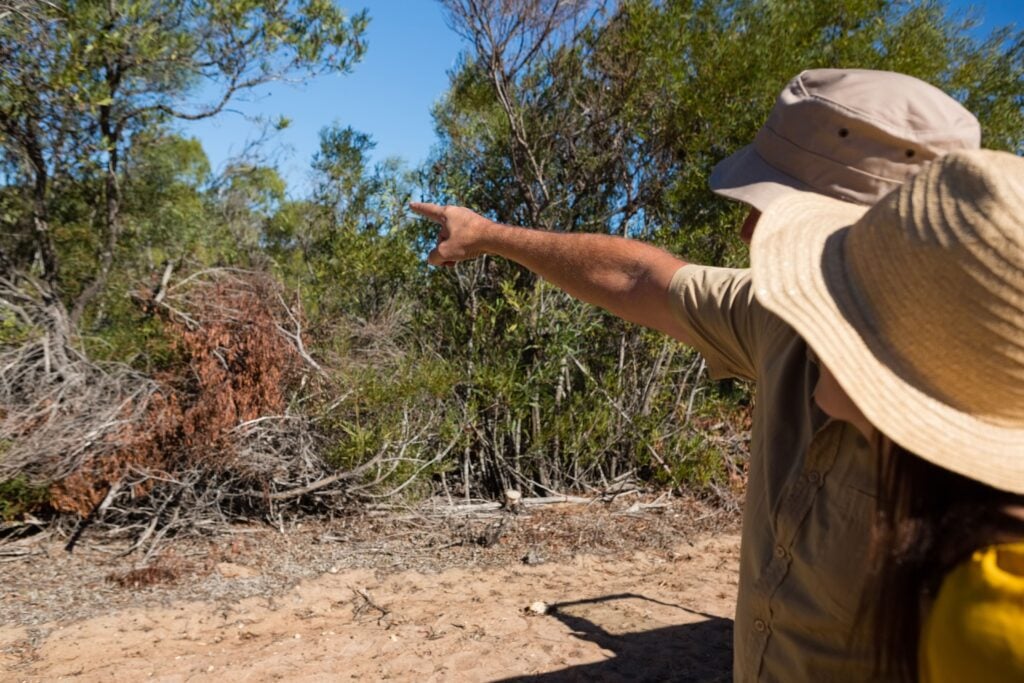
Animal tracks and signs reveal which species passed through, how recently, and what they were doing — without a single sighting. On safari at Kruger National Park, understanding spoor (the collective term for tracks, droppings, markings, and disturbances) transforms a game drive into a living field study. Look for paw shape, stride pattern, claw marks, and dung to piece together each animal’s story.
Why reading spoor changes everything on a game drive
A safari is not only about what you see. It is equally about what the bush is telling you between sightings.
Spoor — the Afrikaans word covering all signs left by animals — includes footprints, droppings, territorial markings, feeding evidence, and disturbed vegetation. Skilled trackers read these signs the way others read a newspaper: quickly, accurately, and with rich context.
At Kruger National Park, one of Africa’s most biodiverse wilderness areas, the ground, trees, and riverbanks hold constant evidence of the Big 5 and hundreds of other species. Knowing what to look for sharpens every moment of your game drives and wildlife experiences.
The core elements of animal tracking
1. Footprint Shape and Size
Every species leaves a distinctive print. Broad categories to know:
- Cloven hooves (split into two lobes): buffalo, impala, kudu, wildebeest
- Round, padded paws: lion, leopard, cheetah, wild dog
- Three-toed, large prints: white and black rhino
- Rounded, single toe: elephant (oval, often 40–50 cm across in adults)
- Small, pointed prints: warthog, bushpig
Size matters, but so does depth. A deeper impression means a heavier animal or softer substrate — not always the same species.
2. Claw Marks
This single detail separates cats from dogs in the field. Lions, leopards, and cheetahs retract their claws when walking, so their prints show no claw marks. Wild dogs, hyenas, and jackals cannot retract claws, so their prints almost always show visible claw indentations above each toe.
This is one of the most reliable identification shortcuts in African tracking.
3. Stride and Gait Patterns
How an animal moves reveals its intent:
Gait Pattern | What It Suggests | Common Species |
Long, evenly spaced strides | Relaxed walking | Elephant, buffalo |
Short, clustered prints | Slow, cautious movement | Leopard stalking |
Widely spaced, asymmetric | Running or fleeing | Impala, zebra |
Diagonal pairs (front + back offset) | Trotting | Wild dog, hyena |
Bounding pattern (prints in groups of 4) | Galloping | Cheetah, mongoose |
Reading gait alongside footprint shape gives you both the species and the behaviour at the time.
Reading signs beyond footprints
Tracks are only one layer. The bush communicates through multiple channels simultaneously.
Dung and droppings
Dung is arguably the most information-dense sign in the bush. It reveals species, diet, health, and — critically — recency.
- Elephant dung: large, fibrous balls; fresh dung steams and smells strongly
- Rhino middens: rhinos deposit dung in communal piles called middens, used for territorial communication
- Lion scat: contains hair and bone fragments; pale grey when dry
- Leopard scat: often deposited on rocks or raised ground to mark territory
Freshness matters enormously. Warm, moist dung means the animal passed very recently. Dry, crumbling dung may be days old.
Territorial markings on trees
Trees are noticeboards in the African bush.
- Claw raking: lions and leopards rake bark to sharpen claws and leave scent from interdigital glands. Parallel vertical scratches at shoulder height indicate a big cat.
- Rubbing marks: elephants rub against specific trees repeatedly, leaving smooth, dark patches on bark. These trees often show broken branches at head height.
- Horn scraping: male buffalo and rhino scrape horns on trees and termite mounds, leaving distinctive gouges.
Feeding evidence
What an animal ate — and how — identifies it almost as clearly as a footprint.
- Stripped bark: elephants and kudu strip bark differently. Elephants leave rough, fibrous tears. Kudu leave clean, angled cuts from their lower incisors.
- Broken branches at height: elephant feeding sign; branches snapped 3–5 metres up indicate a large bull.
- Plucked grass tufts: white rhino graze low and leave characteristic torn, uneven grass patches.
- Kill sites: vultures circling or perched in trees often indicate a predator kill nearby. Look for scattered bones, tufts of hair, and drag marks in the soil.
A step-by-step guide to reading a track scene
Use this process whenever you stop at a promising patch of soft ground or riverbank:
Step 1 — Identify the substrate
Soft sand, mud near water, and dusty roads hold prints best. Rocky or grassy ground rarely shows clear spoor.
Step 2 — Find the clearest print
Look for a single, undisturbed impression. Avoid prints that overlap or have been disturbed by wind.
Step 3 — Assess shape and size
Is it cloven, padded, or rounded? Estimate the width and length in relation to your hand for scale.
Step 4 — Check for claw marks
Look above the toe pads. Claw marks present = dog family or hyena. No claw marks = cat family.
Step 5 — Follow the stride pattern
Walk the line of travel. Note spacing, symmetry, and any changes in gait that suggest the animal paused, turned, or accelerated.
Step 6 — Look for associated signs
Within 10 metres: dung, urine spray, disturbed soil, broken vegetation, or feathers. Each adds context.
Step 7 — Estimate recency
Fresh prints have sharp, crisp edges. Wind and heat erode edges quickly in Kruger’s climate. Crumbled edges suggest hours or days, not minutes.
Big 5 Tracking cheat sheet
Species | Print Shape | Claw Marks | Key Additional Sign |
Lion | Round, padded, 4 toes | No | Raked bark, scat with bone |
Leopard | Round, padded, smaller than lion | No | Scat on elevated ground |
Elephant | Oval, 40–50 cm, circular | N/A | Stripped bark, dung balls |
Buffalo | Cloven, rounded lobes | N/A | Wallowing mud, dung pats |
Rhino | 3-toed, large | N/A | Midden piles, horn gouges |
Tracking in Kruger’s Different Habitats
Kruger National Park spans nearly two million hectares , encompassing riverine forest, open savanna, rocky outcrops, and dense bushveld. Each habitat changes what you find and where.
Riverbanks and waterholes are the most productive tracking zones. Animals visit daily, and soft substrate preserves prints for hours. Morning game drives often reveal the overnight traffic of predators and prey in the sand.
Open savanna shows gait patterns clearly across dust roads but loses fine detail quickly in wind.
Dense bushveld is where feeding signs — broken branches, stripped bark, and disturbed leaf litter — become more valuable than footprints.
Kruger is a year-round destination. Dry-season conditions (roughly May to October) lower vegetation and concentrate animals at water sources, making tracking easier. The wet season brings lush growth and active breeding behaviour, with different but equally rewarding signs to read.
Making the Most of Your Safari Experience
Understanding spoor is a skill that compounds. Each game drive builds your reference library of shapes, sizes, and contexts. The more you look, the more you see.
At Kruger Gate Hotel, positioned directly at the Paul Kruger Gate, guests have immediate access to the park’s southern region — one of the most densely populated areas for Big 5 species. Our game drives and wildlife experiences are led by knowledgeable guides, turning the ground beneath your vehicle into a continuous story.
After a morning in the bush, return to the comfort of our Deluxe Rooms & Suites to review field notes, share photographs, and prepare for the next drive. The rhythm of early mornings and rewarding evenings at Kudyela Restaurant and River Boma is what a Kruger safari is built around.
If you are planning a corporate group retreat that combines team-building with authentic bush experiences, our corporate and private functions team can design a programme around the park’s extraordinary natural environment.
FAQ
Q1: What is spoor?
Spoor is the Afrikaans collective term for all signs left by an animal, including footprints, droppings, territorial markings, feeding evidence, and disturbed vegetation. It is the primary language of wildlife tracking in southern Africa.
Q2: How do you tell a lion track from a leopard track?
Both are round, padded, and show no claw marks. Size is the clearest differentiator: lion prints are significantly larger, typically 10–14 cm wide, while leopard prints measure roughly 6–8 cm. Context — such as habitat and associated signs — also helps confirm the species.
Q3: Is Kruger National Park good for tracking year-round?
Yes. Kruger offers rewarding tracking opportunities in every season. Dry conditions concentrate animals at water sources and expose clearer prints, while the wet season brings fresh vegetation disturbance and active breeding signs. Neither period is superior — they are simply different.
Q4: Can you identify how fresh a track is?
Experienced trackers assess edge sharpness, moisture in dung, and environmental factors like wind and temperature. In Kruger’s heat, a crisp-edged print in dry sand may be only minutes to a few hours old. Crumbled, wind-softened edges suggest older spoor.
Q5: What is the most reliable sign for identifying a predator kill nearby?
Vultures — particularly groups perched in trees or descending in spirals — are the most reliable aerial indicator of a kill site. On the ground, look for drag marks, scattered tufts of hair or feathers, and the strong scent of blood or decomposition.