


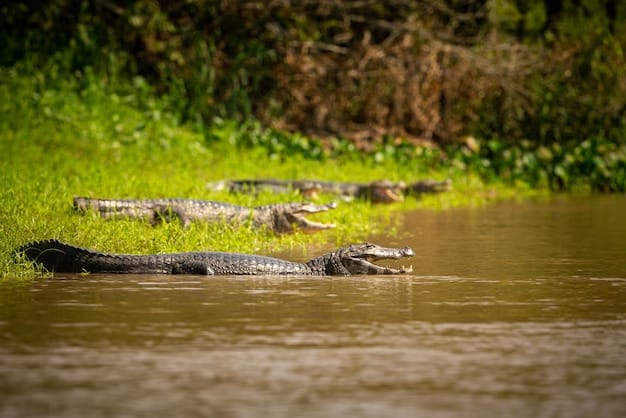
The Kruger National Park crocodile is a Nile crocodile (Crocodylus niloticus) found along the park’s major river systems, including the Sabie, Olifants, and Luvuvhu rivers. These apex predators ambush prey at water’s edge, relying on stealth, explosive speed, and the “death roll” to subdue animals. Kruger supports one of southern Africa’s healthiest crocodile populations, making river habitats prime wildlife-viewing zones year-round.
The Nile Crocodile in Kruger: Africa’s ancient apex predator
Few animals command as much respect — or primal fascination — as the Nile crocodile. In Kruger National Park, these prehistoric reptiles have patrolled the same river corridors for millions of years, largely unchanged by evolution.
Crocodylus niloticus is the largest freshwater predator on the African continent. Adult males in Kruger regularly exceed 4 metres in length and can weigh upward of 400 kg. Females are notably smaller, typically reaching 2.5–3 metres.
The species is not endangered. South Africa’s Kruger population is considered stable and well-managed under the South African National Parks (SANParks) conservation framework.
Where crocodiles live in Kruger National Park
Major river habitats
Kruger’s crocodile population is concentrated along its permanent river systems. These waterways provide the three essentials every crocodile needs: water for thermoregulation, sandy banks for nesting, and reliable prey corridors.
Key rivers where crocodile sightings are frequently reported include:
- Sabie River — The most perennial river in Kruger; supports dense hippo and crocodile populations year-round
- Olifants River — A broader, slower-moving river system in the central and northern regions
- Luvuvhu River — In the far north, this river cuts through dense riparian forest and is particularly rich in wildlife
- Crocodile River — The park’s southern boundary; its name is no coincidence
- Letaba River — A central river system with exposed sandbanks ideal for basking
Why river edges matter
Crocodiles are ectothermic — they rely entirely on external heat sources to regulate body temperature. Sandbanks and exposed rocky outcrops along these rivers serve as critical basking sites, particularly in the early morning.
Water also provides cover. A crocodile can submerge with only its eyes and nostrils above the surface, remaining virtually invisible to prey approaching the bank.
Kruger crocodile hunting behaviour: Stealth, speed, and strategy
The ambush predator model
The Kruger National Park crocodile is the definitive ambush predator. It does not chase prey across open ground. Instead, it positions itself near drinking sites, river crossings, or areas where animals habitually enter the water.
Patience is the primary weapon. A crocodile may remain motionless for hours — sometimes days — waiting for the right opportunity. This energy conservation strategy is highly effective; crocodiles can survive on surprisingly few large meals per year.
The strike
When prey enters range, the crocodile launches from the water with explosive acceleration. The lunge covers short distances — typically under 2 metres — but the speed is formidable, with strike velocity estimated at up to 12 km/h in water.
The crocodile grips with its jaws — among the most powerful bite forces recorded in any living animal, measured at approximately 16,460 newtons in large adults. It does not chew. It drowns.
The death roll
Once prey is seized, the crocodile performs the iconic “death roll” — a rapid, full-body rotation that disorients prey, prevents escape, and tears flesh into consumable portions. This behaviour is instinctive and has been observed even in hatchlings.
Prey species in Kruger
Kruger’s crocodiles are opportunistic and take a wide range of prey depending on size and availability:
Prey Category | Common Species | Notes |
Small prey | Fish, frogs, small birds | Primary diet of juveniles |
Medium prey | Impala, monkeys, monitor lizards | Common for sub-adults |
Large prey | Wildebeest, zebra, buffalo calves | Targeted at river crossings |
Occasional prey | Leopard, lion cubs (rare) | Opportunistic only |
Fish form a significant portion of adult diet in Kruger’s river systems, particularly during dry season when water levels drop and fish concentrate in pools.
Seasonal behaviour and year-round activity
Kruger is a year-round destination for wildlife enthusiasts, and crocodile activity does not follow a simple seasonal on/off pattern.
Dry season (May–October): Rivers recede, concentrating both fish and drinking mammals at remaining water sources. Crocodiles are highly active hunters during this period. Basking behaviour is also more visible as sandbanks become exposed.
Wet season (November–April): Crocodiles remain active but are harder to spot as river levels rise and vegetation thickens. This is nesting season — females excavate sandy bank nests and guard clutches of 25–80 eggs.
Neither season offers a “better” crocodile experience — each reveals different behaviours. This is one reason Kruger Gate Hotel positions the park as a compelling destination throughout the entire year.
Nesting, reproduction, and juvenile survival
Nesting behaviour
Female Nile crocodiles are attentive mothers by reptile standards. After laying eggs in sandy bank nests, females guard the site aggressively for approximately 90 days. They respond to the chirping calls of hatchlings and assist them to the water.
Despite this parental care, juvenile survival rates are low. Predation by monitor lizards, birds of prey, and even other crocodiles means fewer than 1% of hatchlings reach adulthood.
Growth and longevity
Nile crocodiles grow slowly but live long. In Kruger’s protected environment, individuals can live 70–100 years. Large, battle-scarred males visible along the Sabie River may be decades old — living records of the park’s conservation success.
Conservation status and Kruger’s role
The Nile crocodile is currently listed as Least Concern on the IUCN Red List, though populations outside protected areas face pressure from habitat loss and hunting.
Kruger National Park functions as a critical refuge. SANParks’ no-interference policy allows crocodile populations to self-regulate, maintaining ecological balance across the river systems. Crocodiles play a vital role in controlling fish populations and recycling nutrients through their feeding behaviour.
Viewing crocodiles responsibly from Kruger Gate Hotel
Kruger Gate Hotel sits at the Paul Kruger Gate — one of the most iconic entry points into the Kruger National Park. Guests have direct, unfenced access to the park’s southern river systems, including stretches of the Sabie River where crocodile activity is regularly observed from designated viewpoints.
A note on wildlife: Animal sightings are never guaranteed in any wild environment. Kruger’s crocodiles are wild, free-ranging animals that move according to their own rhythms. The experience of searching — and sometimes waiting — is part of what makes Kruger extraordinary.
For guests seeking the full immersive experience, our safari and wildlife experiences place you in expert hands, navigating the river corridors and open savannah of the greater Kruger ecosystem.
After a day on the water’s edge, retreat to the comfort of our Deluxe Rooms & Suites — designed to blend African heritage with contemporary luxury, offering a true sanctuary at the edge of the wild.
Frequently Asked Questions
Are there crocodiles in Kruger National Park?
Yes. Kruger National Park is home to a healthy population of Nile crocodiles, concentrated along permanent river systems including the Sabie, Olifants, Luvuvhu, and Crocodile rivers.
How big do Kruger crocodiles get?
Adult male Nile crocodiles in Kruger can exceed 4 metres in length and weigh over 400 kg. Females are smaller, typically reaching 2.5–3 metres.
What do crocodiles eat in Kruger National Park?
Kruger crocodiles eat fish, frogs, birds, impala, monkeys, and larger prey such as wildebeest and zebra at river crossings. Diet varies by age and season, with fish forming a significant portion of adult intake.
When is the best time to see crocodiles in Kruger?
Crocodile activity occurs year-round. During the dry season (May–October), lower river levels and concentrated prey make hunting behaviour more visible. During the wet season (November–April), nesting behaviour can be observed.
Is it safe to stay near the Kruger crocodile habitat at Kruger Gate Hotel?
Yes. Kruger Gate Hotel is a professionally managed, secure luxury property. Guests enjoy proximity to the park’s river systems through designated, safe viewpoints and guided game drives. Direct, unsupervised access to riverbanks is not permitted.