


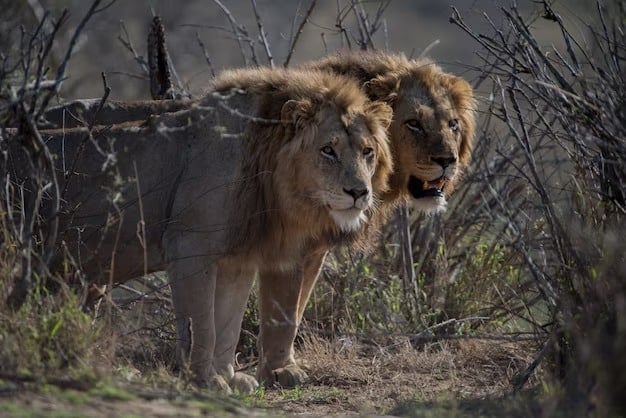
Lions and leopards are both apex predators found across sub-Saharan Africa, including the Kruger National Park region, but they differ significantly. Lions are larger, social, and hunt cooperatively in prides. Leopards are solitary, stealthy, and far more adaptable. Both species are classified as vulnerable by the IUCN. Neither sighting is ever guaranteed on safari.
Why comparing lions and leopards matters on safari
For guests planning a luxury safari in the greater Kruger region, few questions spark more excitement than: lion or leopard?
Both are members of Africa’s celebrated Big 5. Both are powerful, elusive, and deeply woven into the continent’s ecological identity.
Yet they are remarkably different animals — in body, behaviour, and strategy.
Understanding these differences enriches every game drive experience and deepens your appreciation of the African bush.
Physical differences: Size, build, and markings
At first glance, lions and leopards may seem similar — tawny coats, powerful builds, piercing eyes.
Look closer, and the contrast is stark.
The lion (Panthera leo)
The lion is Africa’s largest cat and the second-largest big cat globally, after the tiger.
- Adult males weigh between 150–225 kg and measure up to 2.5 m in body length
- Adult females are notably smaller, averaging 120–182 kg
- Males carry a distinctive mane — darker manes often signal higher testosterone and dominance
- Coat colour ranges from tawny gold to sandy brown
Built for power and endurance over short distances
The leopard (Panthera pardus)
Leopards are compact, muscular, and built for agility.
- Adults typically weigh 17–90 kg depending on sex and region
- Body length averages 1.0–1.9 m
- Coats feature distinctive rosette patterns — hollow spots that distinguish them from cheetahs
- Melanistic (black) leopards exist, often called black panthers, though rare in southern Africa
- Proportionally, they have the longest limbs relative to body size of any big cat
Behaviour and social structure
This is where lions and leopards diverge most dramatically.
Lions: Strength in numbers
Lions are the only truly social big cats in Africa.
They live in prides of 3–30 individuals, typically comprising related females, their cubs, and a coalition of males.
- Females do the majority of cooperative hunting
- Males defend territory and protect cubs
- Communication includes roaring, scent marking, and tactile bonding
- Pride territories in the Kruger region can span 20–400 km²
This social structure makes lions highly visible — and one of the most photographed species in the park.
Leopards: Masters of solitude
Leopards are fiercely solitary outside of mating and cub-rearing.
Each individual holds a defined home range, which it marks with scent and scratch posts.
- Males and females only interact briefly during mating
- Mothers raise cubs alone for up to 18–24 months
- Highly territorial — overlapping ranges often lead to conflict
- Leopards are largely nocturnal but can be active at dawn and dusk
Their secretive nature makes a leopard sighting feel particularly rare — though it is never guaranteed.
Hunting style: Strategy vs. stealth
Few contrasts are as dramatic as how these two species hunt.
Lion hunting tactics
Lions rely on coordination, patience, and explosive group effort.
Females typically fan out and encircle prey, with one or two individuals making the final charge. Prey species include buffalo, zebra, wildebeest, and giraffe.
- Success rate: approximately 17–19% per hunt
- Preferred hunting time: dusk to dawn
- Lions will also scavenge and steal kills from other predators
Leopard hunting tactics
Leopards are ambush hunters of extraordinary precision.
They stalk prey silently, closing distance to within a few metres before striking. Their bite — targeting the throat or back of the skull — is among the most powerful relative to body size of any cat.
- Success rate: approximately 38% per hunt
- Prey ranges from small antelope to warthog, baboons, and rodents
- Leopards famously hoist kills into trees to protect them from lions and hyenas
This tree-hoisting behaviour is one of the most iconic sights in the African bush.
Habitat and range in the Kruger region
Both species inhabit the Kruger National Park and the surrounding private reserves, but they occupy different ecological niches.
Feature | Lion | Leopard |
Preferred habitat | Open savanna, grassland | Dense bush, riverine forest, rocky terrain |
Range in Kruger | Widespread across open zones | More concentrated along rivers and thickets |
Territory size | 20–400 km² (pride) | 5–70 km² (individual) |
Adaptability | Moderate — prefers open terrain | Extremely high — found from coast to mountain |
Visibility on game drive | Relatively high (social, often resting in open) | Lower (solitary, cryptic, tree-resting) |
IUCN Status (2023) | Vulnerable | Vulnerable |
The Kruger National Park is one of the few places in Africa where both species can be encountered in their natural range — year-round.
Conservation status: A shared vulnerability
Despite their power, both lions and leopards face serious conservation pressures.
Lions have lost approximately 43% of their African range over the past two decades. Habitat loss, human-wildlife conflict, and prey depletion are primary threats.
Leopards are the most widespread of Africa’s big cats but are declining across much of their range. Trophy hunting pressure, retaliatory killing by farmers, and bushmeat poaching all contribute.
Responsible, low-impact safari tourism — like the experiences offered at Kruger Gate Hotel — plays a measurable role in funding conservation across the greater Kruger ecosystem.
Lion vs Leopard: A side-by-side comparison
Characteristic | Lion | Leopard |
Average weight (male) | 150–225 kg | 40–90 kg |
Social structure | Pride (3–30 individuals) | Solitary |
Primary hunting method | Cooperative ambush / chase | Solitary stalk and ambush |
Hunting success rate | ~17–19% (Nat Geo, 2022) | ~38% (Panthera, 2021) |
Coat pattern | Uniform tawny | Rosette spots |
Typical activity time | Dusk to dawn | Nocturnal / crepuscular |
Signature behaviour | Roaring, pride bonding | Hoisting kills into trees |
Kruger visibility | Moderate–high | Low–moderate |
IUCN Status | Vulnerable | Vulnerable |
Experiencing both species at Kruger Gate Hotel
Positioned directly at the Paul Kruger Gate — the main entrance to the Kruger National Park — Kruger Gate Hotel offers an unrivalled base for exploring this extraordinary ecosystem.
Our Safari and wildlife experiences are led by knowledgeable professionals who understand predator behaviour, tracking, and responsible wildlife viewing.
After a day in the bush, guests return to deluxe rooms and suites designed as a true sanctuary — blending African heritage with modern luxury.
Wildlife sightings, including lions and leopards, are never guaranteed. What is guaranteed is an immersive, expertly guided experience in one of the world’s most biodiverse safari destinations.
Kruger is a year-round destination. Each season offers distinct wildlife dynamics — and both lions and leopards are present throughout.
Ready to experience Africa’s apex predators in their natural habitat? Explore our safari experiences and browse our luxury accommodation options to begin planning your Kruger escape.
FAQ
What is the main difference between a lion and a leopard?
Lions are larger, social cats that hunt cooperatively in prides. Leopards are solitary, stealthy ambush hunters with rosette-patterned coats. Lions prefer open savanna; leopards favour dense bush and riverine terrain.
Are lions or leopards more dangerous to humans?
Both are wild apex predators and should never be approached. Lions, being larger and group-living, are statistically involved in more human-wildlife conflict incidents across Africa. Leopards, however, are highly unpredictable when cornered or surprised.
Can you see both lions and leopards in Kruger National Park?
Yes. The Kruger National Park supports healthy populations of both species. Leopard sightings are generally less frequent due to their solitary and cryptic nature. Neither sighting is guaranteed on any game drive.
Which is the better hunter — lion or leopard?
By success rate, leopards are more efficient hunters, succeeding in approximately 38% of attempts, compared to lions at 17–19%. Lions compensate through cooperative strategy and the ability to tackle much larger prey.
Is Kruger National Park a good place to see big cats year-round?
Yes. Kruger Gate Hotel positions the park as a year-round destination. Both lions and leopards are resident throughout all seasons, with varying bush density and animal behaviour offering unique experiences at any time of year.