


Few sightings in the African bush stir the senses quite like an encounter with Kruger’s apex predators. Among them, the African wild dog and the spotted hyena are two of the most misunderstood, and most frequently confused, animals in the park. Knowing the difference between these remarkable creatures will deepen your appreciation of every sighting, whether you’ve just returned from a morning game drive or are preparing for your first safari.
This guide answers the most common questions guests ask. And a stay at Kruger Gate Hotel, positioned 100 metres from the Paul Kruger Gate, the premier entrance into one of Africa’s greatest wilderness reserves, can give you a real glimpse into the answer.
Are African wild dogs related to hyenas?
This is perhaps the most common guest question, and the answer is a definitive no. Despite superficial similarities, African wild dogs (Lycaon pictus) and spotted hyenas (Crocuta crocuta) are not related. Wild dogs are true canids, more closely related to wolves and domestic dogs than to anything else on the savanna. Hyenas, by contrast, belong to the family Hyaenidae and are more closely related to mongooses and meerkats. Evolution has shaped two entirely distinct lineages that simply occupy overlapping ecological space.
African wild dog vs. hyena: Physical differences
Size and build
When comparing the African wild dog and hyena, size is your first clue. Spotted hyenas are substantially larger, weighing between 45 and 80 kilograms. Their front legs are noticeably longer than their hind legs with a distinctive sloping back; giving them a hunched, powerful silhouette. African wild dogs are leaner and lighter, typically weighing 20 to 30 kilograms, with a more elegant, leggy build built for endurance rather than brute strength.
Coat and colouring
The African wild dog’s coat is its most arresting feature: a vivid, irregular mosaic of black, white, and amber, no two individuals share the same pattern. This is not camouflage; it is identity. Each dog’s markings are as unique as a fingerprint.
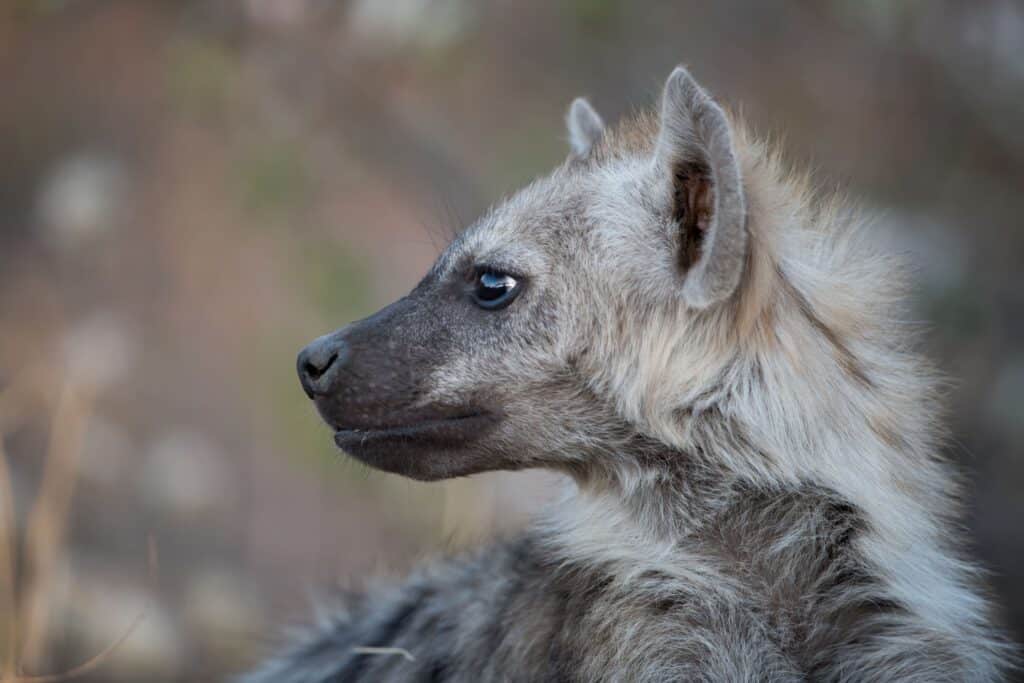
The spotted hyena, by contrast, wears a tawny to grey-brown coat scattered with dark spots, particularly along the shoulders and flanks. Young hyenas are born dark brown and develop their spots as they mature. Where the wild dog looks almost painterly, the hyena has a more uniform, earthy appearance.
Ears
Look at the ears. African wild dogs have large, rounded, almost satellite-dish-like ears, an adaptation for both thermoregulation and exceptional hearing during coordinated hunts. Hyena ears are rounder and smaller in proportion to the head, though still alert and mobile.
Behaviour: African wild dog compared to hyena
Social structure
Both species are highly social, but the nature of their societies differs profoundly.
African wild dogs live in tightly bonded packs, typically of 6 to 20 individuals, structured around an alpha breeding pair. Their social bonds are extraordinary: pack members greet one another with exuberant rituals, care for the sick and injured, and regurgitate food for those who missed a hunt. They are, by any measure, among the most cooperative carnivores on the planet.
Hyena clans can number into the dozens and are matriarchal: females dominate all males, and even the lowest-ranking female outranks the highest-ranking male. Their famous “laugh” is not amusement but communication: a complex vocal repertoire that signals submission, excitement, or alarm.
Hunting strategy
The African wild dog is one of Africa’s most efficient hunters, with a success rate exceeding 80%, far surpassing lions and leopards. They rely on stamina, relentlessly pursuing prey across open ground until exhaustion sets in. Hunts are coordinated, quiet, and breathtakingly organised.
Hyenas are opportunistic omnivores with formidable jaws capable of crushing bone, a skill few predators possess. While popular culture has cast them as scavengers, hyenas are accomplished hunters in their own right, frequently making kills that lions subsequently steal from them rather than the other way around.
African wild dog vs. hyena: Who would win?
This question surfaces regularly, and while it is tempting to frame nature as competition, the reality is nuanced. In direct confrontations, hyenas generally dominate wild dogs due to sheer size and their powerful, bone-crushing bite. A large clan of hyenas will readily steal a wild dog kill. However, wild dogs are not passive in such encounters: the pack will mob and pester hyenas with impressive coordination, and a large pack has been known to successfully defend a carcass.
What makes this comparison fascinating is not who “wins” in the conventional sense, but how radically different strategies (brute force versus cooperative intelligence) play out on the same landscape every single day.
Conservation status: A sobering contrast
Here the two species diverge dramatically in fortune. Spotted hyenas are classified as Least Concern by the IUCN, with an estimated population of 27,000 to 47,000 across sub-Saharan Africa.
African wild dogs, by contrast, are classified as Endangered, with fewer than 6,600 individuals remaining in the wild. They are among Africa’s most threatened large carnivores, lost to habitat fragmentation, human-wildlife conflict, and disease. Kruger National Park is one of the last strongholds for viable wild dog populations on the continent, making every sighting here not merely thrilling, but genuinely rare and precious.
How to spot them on your game drive
African wild dogs are most active at dawn and dusk, largely covering vast distances in a single morning. Ask your ranger about recent pack movements. Packs in Kruger can have home ranges of several hundred square kilometres, but dedicated trackers and field guides maintain contact with resident packs. Watch the greeting ceremony when you find them: the joyful chaos of a pack reuniting is among the most moving spectacles the bush offers.
Spotted hyenas are largely nocturnal but are frequently seen at dawn near waterholes or following predator activity. Listen for their calls at night from the comfort of the hotel, on a still evening, the whooping chorus of a hyena clan carries for kilometres.
Experience both from Kruger Gate Hotel
Kruger Gate Hotel’s privileged position means your guide is inside the park within minutes of sunrise, when both species are at their most active. Our expert rangers bring decades of field experience and genuine passion to every drive, transforming a sighting into a story you will carry long after you leave.
The African bush has a way of revealing something new each time, whether you are a first-time safari guest or a seasoned wildlife enthusiast. Book your stay at Kruger Gate Hotel and let the wilderness do the rest.
Frequently asked questions
Are African wild dogs and hyenas the same animal?
No. African wild dogs (Lycaon pictus) and spotted hyenas (Crocuta crocuta) are entirely different species from different biological families. Wild dogs are canids, related to wolves and domestic dogs. Hyenas belong to the family Hyaenidae and are more closely related to mongooses. They share a landscape but not a lineage.
What is the main difference between an African wild dog and a hyena?
The most immediately visible differences are size, build, and coat. Hyenas are significantly larger (45–80 kg vs. 20–30 kg), with a sloping back and a tawny spotted coat. African wild dogs are slender and long-legged with a unique tri-coloured coat of black, white, and amber. No two individuals are identical. Their ears are also a reliable tell: wild dogs have large, rounded ears; hyena ears are smaller and more pointed.
Who would win in a fight: an African wild dog or a hyena?
In a direct one-on-one confrontation, a spotted hyena would almost certainly prevail. It is larger, heavier, and possesses one of the most powerful bites in the animal kingdom. In practice, however, the dynamic is pack versus clan: a large wild dog pack can successfully mob and drive off hyenas, while a large hyena clan will overpower and displace wild dogs from a kill. Neither species routinely seeks out the other for combat.
Are African wild dogs related to hyenas?
No. This is a common misconception. Despite both being African predators with social structures and spotted or patchy coats, they are not related. Wild dogs are true canines; hyenas are more closely allied with the Feliformia suborder (cats, mongooses, civets). Their similarities are a product of convergent evolution, not shared ancestry.
Which is more endangered: the African wild dog or the hyena?
The African wild dog is significantly more endangered. Fewer than 6,600 remain in the wild, and they are listed as Endangered on the IUCN Red List. Spotted hyenas are listed as Least Concern, with a population estimated between 27,000 and 47,000. Kruger National Park is one of the most important refuges for wild dog conservation in Africa.
Where is the best place to see African wild dogs and hyenas in Kruger?
Both species range widely across Kruger, but your best advantage is an early start through the Paul Kruger Gate; the park’s most central entrance and the one closest to Kruger Gate Hotel. Wild dogs are most active at dawn; hyenas are frequently spotted near waterholes and predator kills in the early morning hours. Staying directly at the gate means you are in prime territory before other vehicles have even entered the park.
What sound does a hyena make?
The spotted hyena produces a remarkable range of vocalisations, including the distinctive “laugh,” a series of rapid, high-pitched calls used to communicate excitement, submission, or social tension within the clan. They also emit long whooping calls that carry several kilometres across the bush, often audible from Kruger Gate Hotel at night.
Do African wild dogs and hyenas ever interact in the wild?
Yes, and frequently. Their ranges overlap considerably in Kruger, and they compete directly for prey. Hyenas will follow wild dog hunts and attempt to steal kills; wild dogs respond by mobbing in numbers. These interactions are among the most dramatic and unpredictable encounters the bush offers, a reminder that life in Kruger is a continuous negotiation between survival strategies.